There has been much talk about student-centred
classrooms and students being in control of their own
learning. Such notions, even with good intentions,
create tensions in classrooms as the power relations
between teachers and students are never equal. Students
expect teachers to take charge and to teach; teachers
expect students to learn and to know who is in charge!
Everyday classroom spaces are clearly not ideal for
teachers to become learners and learners to be teachers
in role reversals that lead to both learner and teacher
empowerment.
Teachers of English in training and teachers pursuing
postgraduate degrees at The University of the West
Indies, Mona Campus have carved out a new dialogic space
in their dual roles as teachers and learners preparing
to teach English language and Literature in
Creole-speaking environments.
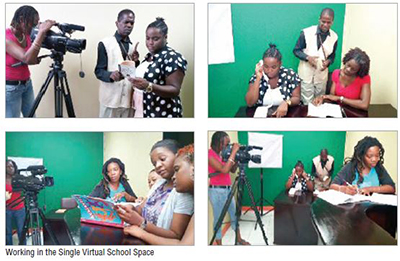
This Single Virtual School Space (SVSS) in the form of a
computer technology –enhanced Television Studio that
links School of Education with Caribbean classrooms, was
birthed out of a fiveyear intervention in which teachers
pursuing undergraduate courses that support the delivery
of the CSEC English syllabus planned, staged and filmed
their assignments for assessment in the form of
conferences, Readers Theatre,
seminars and workshops before live audiences of 1550
students from selected schools. The films were usually
edited into 30 min sessions, and taken to local cable
television operating in confined geographical spaces for
dissemination as examination revision sessions. There
was need for a physical but wall -less space on the Mona
Campus that merges teachers’ learning, students’
learning, syllabus inquiry, research and innovation.
This search gave birth to the appropriation of the
television studio into a place with pedagogical
significance for the professional development of
teachers and the improvement of student learning.
Today, the SVSS breaks away the walls of fixed
classrooms and geographically confined -cable television
spaces and transforms university classrooms into
televised -theatre-settings which engage secondary
school students preparing for CSEC and CAPE English and
their teachers in syllabus inquiry, innovation and
experiment. The SVSS now facilitates the dissemination
of information and engagement with a larger audience
through live streaming and the archive of films on the
SVSS webpage.
THE TELEVISION LEARNING STUDIO: PHILOSOPHY, PEDAGOGY &
PRACTICE
This new television pedagogical space is cognitive,
professional and reflective in nature and synchronizes
teaching and learning and research in a university
setting with teaching and learning in everyday
classrooms. It is framed by the belief that the
television is an arena for teaching and learning that
promotes best quality practices and performances from
teachers and students. The use of the camera in
teachers’ professional space places their practice
under the microscope of self-scrutiny and to be
scrutinized by others. This is nurturing a
teacher-in-built quality assurance mechanism in the
search for new ways of knowing and doing. These new
teacher – learner dispositions are providing new
knowledge and insights for practice that map curriculum
and syllabus goals and expectations with the closing of
gaps in student learning and achievement. This
synchronization of curriculum experiences through film
is nurturing a wall- less classroom practice that is
pedalled and sustained by a pedagogy of enjoyment and
engagement in real-life learning contexts.
BUILDING A PERFORMANCE-RICH ENVIRONMENT THAT PROMOTE
VISUAL LITERACY IN THE STUDY OF LITERATURE
The concept of a performance rich classroom environment
has emerged out of teachers’ and students’ explorations
with process drama in the staging of literature texts on
the CSEC syllabus for filming.
These explorations inject a performance quality in
novels, plays, short stories and poetry to give students
greater access to texts through listening,
speaking and viewing. This has strengthened the need for
building visual literacy in the study of literature in
Creole-speaking environments where students are not
motivated to read the texts selected for study. The
television provides a space for reading into texts and
seeing through texts. These new ‘reading’ dispositions
are modelling and paving the way for greater learner
empowerment and autonomy in regular classrooms. Schools
participating in the televised events are given
pre-conference peer-teaching tasks which engage them in
the stage productions alongside teachers.
 |
NEW WAYS OF DOING AND NEW SITES FOR TEACHER TRAINING &
PROFESSIONAL DEVELOPMENT
In 2012 the undergraduate course TheTeaching of
Literature in the Secondary School, which charted this
innovation was awarded The UWI Best Practice in
Education Content and Quality for the Caribbean as part
of the Vice Chancellor’s Initiative for institutional
excellence. The best practice findings were applied to
other undergraduate and post graduate courses: exemplary
in quality to produce superior results; efficient
resources; engagement of internal and external
stakeholders; documentation, utility and recognition
beyond the practice site. This has exposed 1, 226
student teachers of English as well as teachers beyond
practice site to the innovative pedagogy. This SVSS
teaching-learning space now twins media education with
language education. It is widening the scope of the
service learning that is built into university
undergraduate and post graduate programmes in language
education. All courses which engage teachers in
the delivery of CSEC and CAPE English have assessment
components that involve the use of the television studio
as a platform for engaging students in skills
development for syllabus mastery or for sharing
classroom research that inform teacher pedagogy in the
teaching of English and teaching in English in other
subjects.
The new Bachelor in Language Education and Media Studies
has emerged out of this innovative teacher assessment
for learning space and student alternative learning
space that close gaps in syllabus goals and
expectations for teachers and students. This creative
teacher-student learning space is forging new
partnerships with the university radio for teacher and
student education and development.
SCHOOL OF EDUCATION AND NEWS TALK 93FM COLLABOURATION
A university radio station is strategically positioned
to sustain a break-away from four-walled classroom
spaces into a single real as well as virtual space for
teaching and learning. The School of Education has
charted this transition through partnership with the
Mona Campus' radio station, News Talk 93 FM. The Radio
Active Classroom now being aired on News Talk 93 FM
expands the SVSS modality to a radio in education
environment.
The new partnership integrates radio as a new teaching
learning space and a platform for modelling classroom
pedagogy and School Based Assessment (SBA) as learning.
The synchronization of the School of Education physical
classroom space with university radio studio space
provides real and virtual learning solutions for
improvement in the quality of secondary and tertiary
education through research and innovation. This Single
Virtual School Space has the potential to
institutionalize media technologies as integral
components of teacher education and training.
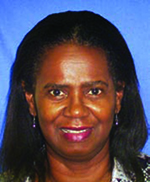
Dr. Paulette Feraria is a lecturer in
Language, Literature and Literacy Education in the
School of Education, The University of the West Indies,
Mona campus. Her classroom praxis and research are
underpinned by critical thinking and critical pedagogies
from ‘outside the box’, which result in alternative and
new ways of doing and knowing.